

Main image
Click to view image in fullscreen
![]()
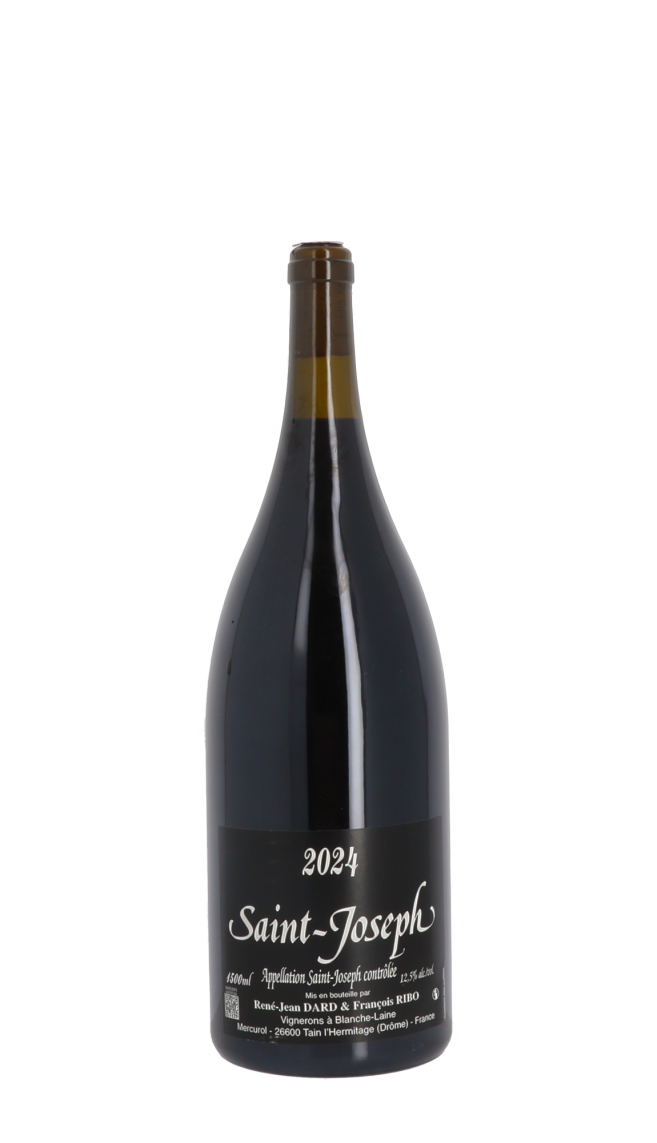
Domaine Dard et Ribo 2024 Rouge
Appellation :
St Joseph
€138.00
Incl. Tax
- Per unit
- Magnum
Stock available in stores
-
31 Av. Franklin Delano Roosevelt 75008 Paris
- Paris
- 8ème
Tel: 01 82 82 33 33 -
135 Av. Jean Jaurès 33600 Pessac
- Pessac
- Pavillon Catelan
Tel: 05 47 50 17 17 -
3 Place Tourny, 33000 Bordeaux
- Bordeaux
- Tourny
Tel: 05 47 50 55 55
In-store stock does not take into account availability at our warehouse.
Item available for click & collect within 6 working days. In case of emergency, please contact us.
The available formats:

Fast and secured delivery worldwide

Free click and collect at La Cave du Château

Direct sourcing and storage
under controlled temperature

Secured payment
The product
In details
-
Flavouring
black fruits, spicy
-
Grape Varieties
Syrah 100%
The producer
Domaine Dard et Ribo
Far from the limelight, Domaine Dard et Ribo, located in the heart of the Crozes-Hermitage appellation, is a pioneer of natural wines in the northern Rhône.
The creation of the estate dates back to 1984. René-Jean Dard's father farmed a few vines for his personal consumption. Upon his death, his son decided to take over the family vines and to cultivate them without recourse to chemistry. At the same time, he made the acquaintance on the school benches of Beaune of François Ribo. The two companions and future partners agreed on the same vision of wine work. They created their estate in Mercurol, a commune located at the crossroads of the Crozes-Hermitage, Saint-Joseph and Hermitage appellations. Over time, the estate has grown from 1 hectare to about 9 hectares today. In the image of a Marcel Lapierre in Beaujolais, René-Jean Dard and François Ribo were influenced by the works of Jules Chauvet and Jacques Néauport, creators of vinification without sulfur. Even so, the wines signed Dard et Ribo resemble only themselves : tasty syrahs marked by flavors of olives or smoke and whites bursting with sunshine and minerality. To characterize the different appellations they produce, René-Jean Dard is accustomed to saying that Saint-Joseph, on the Ardèche bank, embodies the finesse of syrah, while Crozes-Hermitage and Hermitage, Drôme vineyards, represent the power of this grape variety. The Crozes-Hermitage appellation represents the major part of the estate's production. In the Mercurol sector, the soils are composed of clays, sands and rolled pebbles which release heat during the night. It is here that the cuvées focused on indulgence and precocity are produced, such as the famous « C'est le Printemps ». The Larnage sector in the Crozes-Hermitage appellation possesses geological specificities. One finds there kaolin soils and red clays. These terroirs confer to the wines a superior tension and complexity. The estate owns several plots there such as Les Bâties (2.5 hectares of red clay and rolled pebbles planted with old vines) and Pé de Loup (a windier sector planted on white granite gravels).
In Saint-Joseph, on the right bank of the Rhone, the estate cultivates plots located between Mauves and Tournon, as well as in Saint-Jean-de-Muzols and Vion. Here, it is granite that dominates bringing to the syrahs spicy notes and a more slender structure. The cuvée Les Champs coming from a steep slope of hard granite, quartz and red clays hosts syrahs planted in 1955-1960. The wine is renowned for its refined power and its great minerality. The cuvée le Pitrou in Saint-Jean-de-Muzols comes from a terroir of sandy granite (vines from 1940-1950). It produces wines of a great aromatic finesse.
In the Hermitage appellation, René-Jean Dard and François Ribo farm about 0.4 hectares on the lieu-dit Varogne and about 0.13 hectares in the lieu-dit Les Murets. The production of Hermitage, both in red (syrah) and in white (mostly roussanne), constitutes the qualitative peak of the estate. The Varogne terroir, complex, is marked by very old vines (some dating from 1910) and an exposure that favors a slow ripening. The estate practices organic and biodynamic agriculture without official certification. The vinification is of a non-interventionist type, a process which in reality requires constant attention to avoid fermentation problems. For the red wines, about 10 % of the harvest is trodden by foot in the bottom of the vats. This released juice allows the start of alcoholic fermentation while maintaining the rest of the harvest in whole clusters (not destemmed). The presence of stems, if they are well ripe, helps to drain the pomace cap, while bringing freshness to the wine. Macerations are generally long for the age-worthy cuvées (two to three weeks), and shorter for the cuvée « C'est le Printemps ». The estate uses an old vertical press bought from Domaine Prieuré Roch in 1992. The aging takes place in old barrels of 228 liters and especially demi-muids of 600 liters for a duration varying from 11 to 15 months depending on the vintages and the appellations. The wines are then bottled without fining or filtration. The single-plot crozes-hermitages (Les Bâties, Pé de Loup) show more structure and density, with notes of black fruits and spices.
The saint-joseph Les Champs and the hermitage (reds) are powerful but refined wines, with aromas of pepper, licorice and violet, endowed with a great aging potential.
The wines of the estate have today become references for natural wine lovers across the world.